

Weekly Briefing: A Memorandum Without Any Understanding
The fragile ceasefire could soon be replaced, tumultuously, by a Memorandum that leaves more questions than answers.

An MoU between the United States and Iran has been announced, the details of which are as scarce as they are conflicting.
What is clear at the time of writing: nothing has been formally signed, and on several points, Iran and the US appear to have different understandings of what the next steps actually look like.
Just take a look at what Trump posted on Friday, as details of the MoU’s terms started to emerge online:
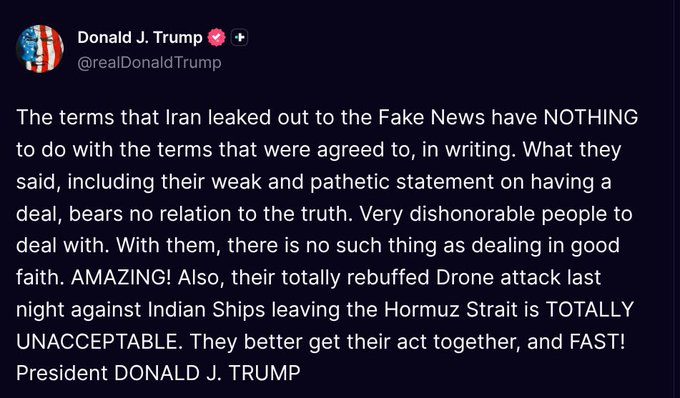
1. What was agreed and what wasn’t
At its core: an end to hostilities across all fronts. Some reporting out of the US suggests the MoU includes an Iranian commitment not to fund terror groups abroad, the destruction and removal of enriched material, the dismantling of Iran’s wider nuclear program, the reopening of the Strait of Hormuz, and the release of frozen Iranian assets and funds, contingent on their compliance with the deal. Other sources quoting Iranian-backed media claim that the US would, in addition to lifting the naval blockade, commit to not stationing any additional troops in the region. Several of these concessions, if true, would have been difficult to imagine even weeks ago.
And yet the MoU’s most revealing feature is not what it contains, but what it fails to include, namely the question of Iran’s nuclear programme.
That exact question, and the details around it, have animated years of sanctions, proxy warfare and now direct military confrontation. It has been deferred to a subsequent negotiation whose terms and 60-day timeline insert new ambiguities, new timelines and new space for disagreements to arise.
What has been announced, then, is not a peace deal. It is a diplomatic pause, one that pushes the hardest disagreements down the road rather than resolving them. And crucially, the document has not yet been signed.
2. Iran appears to emerge with subtle wins
Despite conflicting reports on what is and isn’t included in the MoU, the number of points appears to reflect the same number of points (14) that Iran had presented back in early May. This is significant because it suggests that Iran’s framework, at least in part, has prevailed throughout the last six weeks.
So with this in mind, it’s worth looking at what this deal affords Iran.
Consider the Strait of Hormuz. Iran may nominally relinquish active military control under the new terms within this MoU, but the Persian Gulf Strait Authority (the body Iran established to administer the waterway) will continue to exist. It may even continue to collect tolls. And that’s despite Trump claiming that the Strait of Hormuz will be open ‘immediately’ after the MoU’s signing, without tolls. The infrastructure, the institutional architecture, and the practical know-how of Iranian management of the Strait will not disappear. It will instead become a strategic precedent and a lever Iran can reach for more easily now.
The same logic applies along Iran’s southern coastline. Every military site struck during the conflict will be rebuilt. Iran will likely invest heavily in asymmetric capabilities in the region, the kind of dispersed, hard-to-target systems that proved so costly to confront during the war. Nothing in the MoU appears to prevent this. If anything, the ceasefire and the prospect of sanctions relief give Iran the financial resources to do it properly.
Most consequentially, Iran now has something it lacked before the ceasefire: breathing room. Time to reconstitute its nuclear capabilities, to establish new facts on the ground, to present any future negotiating partner — the United States, the UN, or even the Europeans — with a programme that has advanced during the pause.
3. The one variable that could unravel everything
One particular detail in the MoU may prove to be the most consequential.
The MoU itself presumably covers a cessation of hostilities on all fronts. From an Iranian - and presumably an American perspective too, now, this includes Lebanon.
Israel has already made clear it will not be party to the understanding. That is unsurprising, yet nonetheless significant. One of the primary reasons previous ceasefire attempts collapsed — and one of the proximate causes of renewed US-Iran exchanges in recent weeks — was Israel’s continued operations against Hezbollah in Lebanon. Those operations became a persistent source of escalation that neither Washington nor Tehran could fully contain.
The MoU now presumably asks Israel to stop its attacks in Lebanon.
Israel’s security establishment likely sees a dangerous compounding of threats: Iran’s nuclear programme deferred rather than dismantled, Hezbollah intact in Lebanon, and Israeli freedom of action in the north now cast as an obstacle to a peace process it was never invited to shape. And to top this off: Iran, weaker and more dangerous than ever, is now shaping the terms of an agreement with its primary ally.
How Israel responds to that, on the ground in Lebanon, may well determine whether the MoU survives long enough to be signed at all.